
Understanding Scope and Severity
This newsletter provides healthcare facilities with essential insights on CMS and accreditation surveys, focusing on Scope and Severity, the Survey Matrix, and Immediate Jeopardy.

Depending on whether your facility is a Hospital, Nursing Home, or Surgery Center and whether you are being surveyed by CMS or an accreditation company, you may have heard leadership ask:
- What’s that deficiency scoped at?
- Is that a condition-level deficiency?
- Is this Immediate Jeopardy?
What is Scope and Severity?
Scope and severity is a system used by CMS to determine the seriousness of deficiencies identified during surveys of healthcare facilities.
- A deficiency occurs when a facility does not meet a regulatory requirement.
- The scope and severity of a deficiency depend on its extent and impact on the health and safety of residents.
Scope Levels
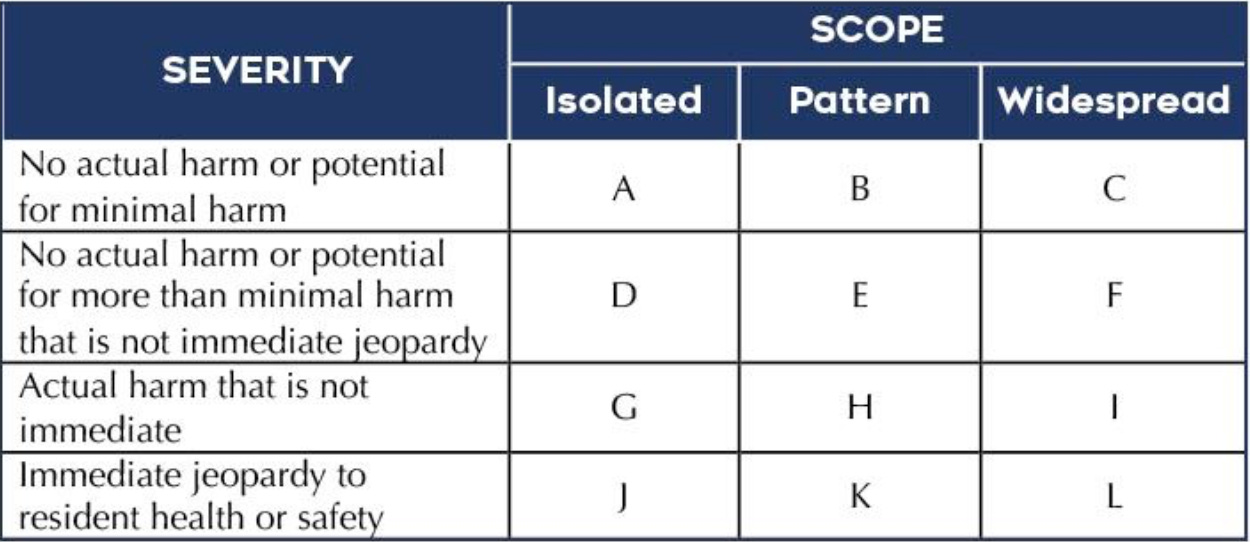
The scope of a deficiency is categorized as isolated, pattern, or widespread, based on how many residents or employees are affected and the extent of the deficiency throughout the facility:
- Isolated: Affects a very limited number of residents, employees, or locations.
- Pattern: Affects more than a limited number of residents, employees, or locations but is not widespread.
- Widespread: The deficiency is systemic, affecting multiple locations or a large portion of the facility.
Severity Levels
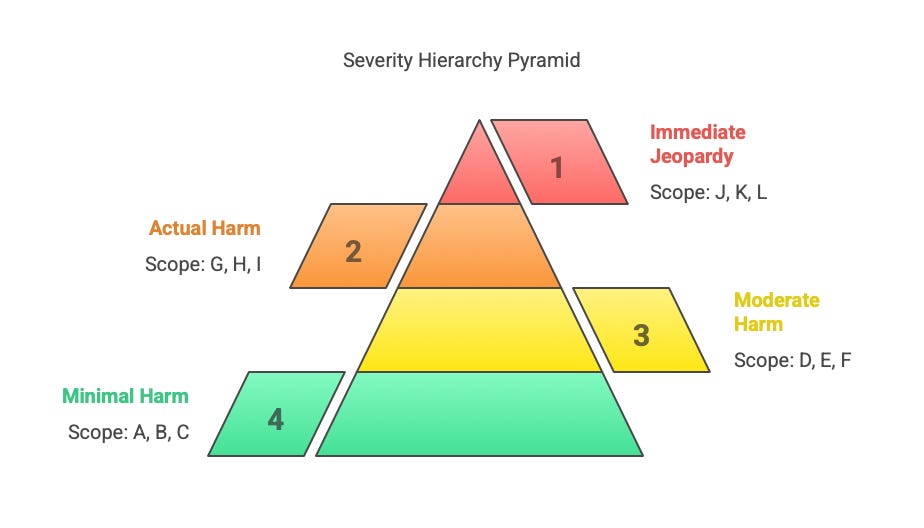
The severity of a deficiency is categorized into four levels:
- Level 1 (A, B, C): No actual harm with the potential for minimal harm.
- Level 2 (D, E, F): No actual harm but potential for more than minimal harm that is not Immediate Jeopardy.
- Level 3 (G, H, I): Actual harm that is not Immediate Jeopardy.
- Level 4 (J, K, L): Immediate Jeopardy to resident health or safety.
How Scope and Severity Apply to Healthcare Facilities
- Hospitals and Surgery Centers with CMS Surveys
- These facilities will have K-Tag numbers but no assigned scope and severity.
- Certain K-Tags automatically trigger a condition-level deficiency, though surveyors may not always realize this unless they have recently cited that specific K-Tag.
- Joint Commission Surveys and the SAFER Matrix
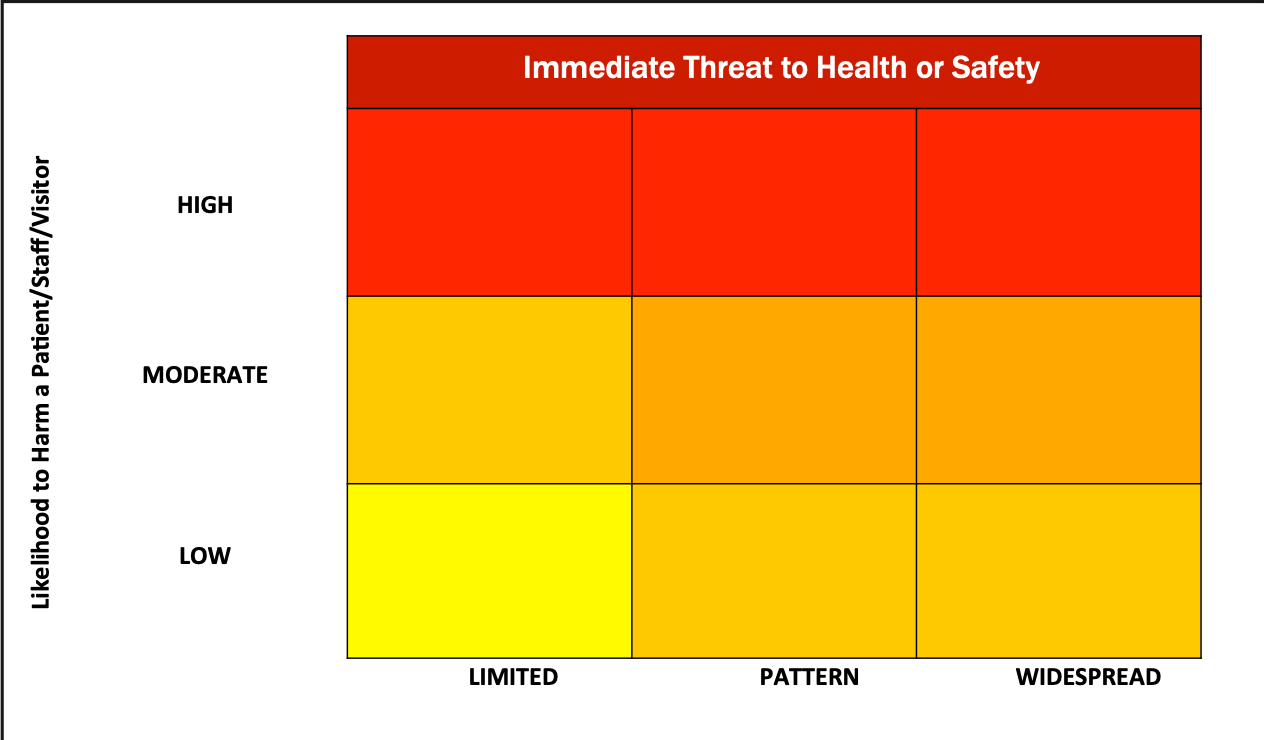
- Joint Commission uses the SAFER Matrix to determine compliance.
- If an Element of Performance (EP) is found out of compliance, it is cited as a Requirement for Improvement (RFI).
- RFIs are placed in the SAFER Matrix based on:
1. Likelihood of harm (Low, Moderate, High)
2. Scope (Limited, Pattern, Widespread)
- Findings increase in severity from the bottom-left (low risk) to the top-right (high risk) of the matrix.
How Do Surveyors Interpret the Matrix?
Surveyors determine deficiencies based on observations, interviews, and documentation reviews. Some deficiencies are automatically cited, but their scope may vary depending on the number of occurrences.
For example:
- A hazardous room must have a self-closing door. If one room has a removed door closer, it is typically scoped at D (isolated deficiency).
- If multiple hazardous rooms have missing door closers, the scope increases to E (pattern deficiency).
- If the issue is facility-wide, the scope rises to F (widespread deficiency).
- There is no exact number that dictates when a deficiency moves to the next level—surveyors use judgment based on the facility’s size and circumstances.
Immediate Jeopardy Examples
Some deficiencies are severe enough to be immediately escalated to Immediate Jeopardy, such as:
- A fire pump that is impaired or non-functional.
- Magnetically locked egress doors that fail to release per code requirements.
Understanding the Survey Matrix helps facilities prepare for CMS and accreditation surveys, address deficiencies proactively, and ensure compliance with life safety and healthcare regulations.
How I Can Help
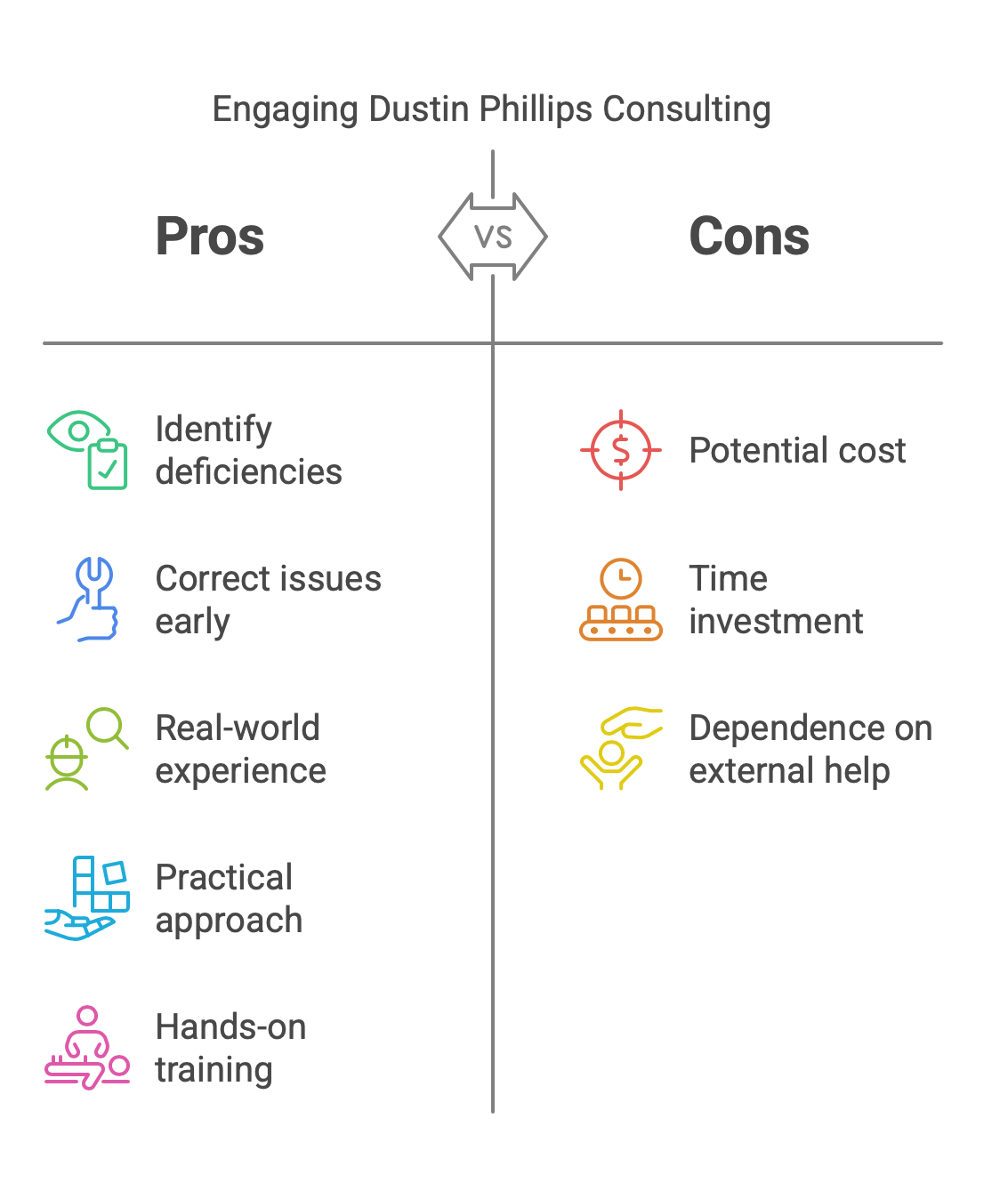
Staying ahead of life safety compliance doesn’t have to be overwhelming. At Dustin Phillips Consulting, I make it easy for you and your staff to understand what’s required, prepare for surveys, and improve safety in your facility.
Whether it’s mock surveys, staff training, or a second set of eyes on documentation and fire safety plans, I bring real-world experience and a practical approach to compliance. My goal isn’t just to find issues—it’s to help you fix them before they become citations.
If you’re looking for clear guidance, hands-on training, and a partner who makes life safety surveys easier, let’s connect. A conversation today could save you a headache tomorrow.
Share & Stay Connected
Know someone who could benefit from this newsletter? Share it with your colleagues and friends—because life safety compliance is easier when everyone is informed.
Have someone who can benefit from Life Safety Newsletters like this but that is not on LinkedIn? Subscribe to my newsletter on Substack, The Code Chase. Newsletters can be sent directly to your colleagues, leadership, or friends email inbox!
For more insights, updates, and compliance tips, connect with me:
🌐 Website: www.dustinphillipsconsulting.com – Learn more about my services, including mock surveys, training, and compliance support.
📩 The Code Chase Newsletter (Substack): Stay ahead of life safety compliance with The Code Chase, a newsletter delivered straight to your inbox. Get valuable insights, compliance tips, and industry updates—right where you need them. Share it with your colleagues, leadership, and friends to help them stay informed!
🔗 Linktree: Dustin Phillips Consulting – Access all my resources in one place, including important industry websites like CMS, CDC, NFPA, and more. You can also find this link on my LinkedIn and Instagram profiles.
💼 LinkedIn: Dustin Phillips Consulting – Follow for regular posts, compliance tips, and industry insights.
📸 Instagram: @DustinPhillipsConsulting – See posts on common deficiencies, compliance tips, and insights to help you stay prepared.
Let’s keep the conversation going—I’d love to hear your thoughts and answer any questions you have!
Let’s talk—reach out today!